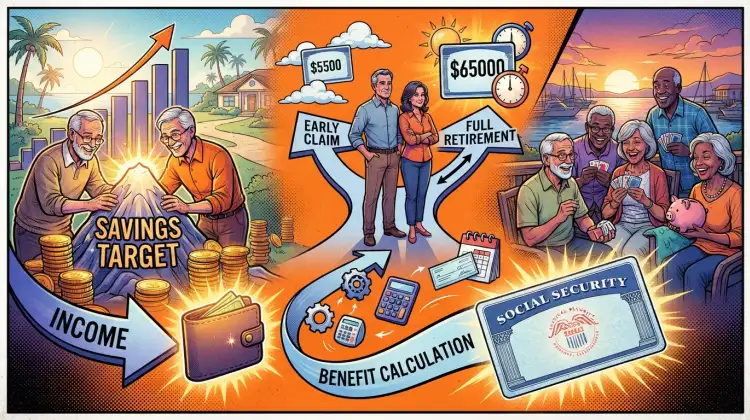
Social Security is the foundation of most Americans' retirement income, yet the rules behind it remain poorly understood. According to the Social Security Administration (SSA), the program paid benefits to roughly 68 million people in 2024, and for many retirees it supplies the majority of their monthly income. Understanding the basics — how your benefit is calculated, when you can claim, and how your decisions affect the amount you receive — is essential to preparing financially for life after work.
How Your Benefit Is Calculated
Your Social Security benefit is based on your earnings history, not on your savings or net worth. The SSA takes your highest 35 years of indexed earnings, averages them into a monthly figure, and applies a progressive formula to arrive at your primary insurance amount (PIA). That PIA is the benefit you would receive if you claim at your full retirement age.
- Years with no earnings count as zeros in the 35-year average, which can lower your benefit.
- Only earnings up to an annual taxable maximum count toward your benefit — $168,600 in 2024.
- You need 40 credits (about 10 years of work) to qualify for retirement benefits.
You can review your earnings record and estimated benefit anytime by creating a my Social Security account at ssa.gov. Checking it periodically helps you catch errors before they affect your payout.
Full Retirement Age and the Claiming Decision
Your full retirement age (FRA) depends on your birth year. For anyone born in 1960 or later, FRA is 67. Claiming before FRA permanently reduces your benefit; claiming after FRA increases it.
- Claim at 62: Your benefit is reduced by up to 30% compared with your PIA.
- Claim at FRA: You receive 100% of your PIA.
- Claim after FRA: Your benefit grows by 8% per year (delayed retirement credits) until age 70, after which there is no further increase.
The break-even point — where delaying outweighs the early reduction — typically falls in your early-to-mid 80s. Health, family longevity, other income sources, and whether you plan to keep working all factor into the decision.
Spousal, Survivor, and Working While Claiming
Married couples have additional options. A spouse can claim up to 50% of the worker's PIA at their own FRA, and survivors can receive up to 100% of a deceased spouse's benefit. Coordinating claiming strategies between spouses can meaningfully raise household lifetime benefits.
If you claim before FRA and continue working, the earnings test may temporarily withhold part of your benefit. In 2024, the SSA withholds $1 for every $2 earned above $22,320. The withheld amount is not lost — it is recalculated into your benefit once you reach FRA.
Taxes, COLAs, and Medicare Premiums
Social Security benefits can be subject to federal income tax depending on your combined income, and up to 85% of benefits may be taxable at higher income levels. Many states also tax benefits, though several do not.
Benefits receive annual cost-of-living adjustments (COLAs) to help offset inflation. In 2025, the COLA was 2.5%. Note that Medicare Part B premiums are typically deducted directly from your monthly check, so your net deposit can be lower than your gross benefit.
What to Remember
Social Security basics come down to a few durable facts: your benefit is built from your 35 highest earning years, your full retirement age is likely 67, and every year you delay claiming past FRA adds 8% until age 70. Check your earnings record annually, weigh the claiming decision against your health and other income, and account for taxes and Medicare premiums when budgeting. Used deliberately, Social Security can anchor a retirement plan rather than simply supplement it.